


Odvetniška družba Neffat in partnerji o.p., d.o.o.
Miklošičeva cesta 18, 1000 Ljubljana, Slovenija
- Telefon: 01/300-00-70
- e-pošta: info@neffat.si


16.12.2024
The current year is proving challenging for the German automotive manufacturer Volkswagen (VW). In April 2024, Euronews reported:
»The company (VW) said in its latest financial update on 10 April that sales of all-electric vehicles declined by 24% in Europe, while sales grew by 91% in China, year-over-year. However, overall, the company said it increased its vehicle deliveries by 3% to 2.10 million vehicles with the main drivers being China, South America and North America.
"Vehicles with combustion engines increased by 4% to 1.97 million units, overcompensating the slight decline of 3% to 136,400 all-electric vehicles (BEV). In this segment, strong growth in China (+91%) did not fully offset the decline in Europe (-24%).
"However, incoming orders for BEVs in Western Europe developed positively from January to March. More than twice as many all-electric models were ordered as in the same period last year (+154%), so that the BEV order bank currently stands at around 160,000 vehicles," a company statement said. «1
In October 2024, VW experienced a further setback when earnings before tax declined by almost 60% to €2.4 billion in the quarter from July to September. This represents a significant decrease from the €5.8 billion recorded a year earlier.2 In response to the challenges facing the automotive industry, Volkswagen has announced plans to consolidate its production capacity in Germany by closing at least three factories and reducing its workforce by tens of thousands.3 Furthermore, the newly elected President of the United States, Donald Trump, is already initiating measures that could potentially lead to a trade war with the country's largest trading partners. Furthermore, the recently elected President of the United States, Donald Trump, is already initiating measures that could potentially lead to a trade war with the country's largest trading partners4 and the European Union (EU). This is in line with the recommendations set forth in the Europe's Environment — State and Outlook Report (SOER 2020), which aims to accelerate the uptake of electric vehicles (EV). This is a sector where Volkswagen (VW) faced significant challenges in 2024. Potential measures include regulatory incentives such as sales targets for electric vehicle manufacturers or bans on sales of internal combustion engine vehicles, as well as financial support for the electric vehicle industry.5
It is evident that the transition to electric vehicles (EVs) represents a significant challenge for Volkswagen (VW). This is not a matter of expertise in marketing or finance; it is a fact that anyone can recognize. With a history of over 60 years in the automotive industry, Volkswagen has established a strong track record in sales, market adaptation and financial stability. It is this author's view that the issue stems from a lack of familiarity with the technological advancements involved, rather than a deficiency in engineering car development, which has been a core strength of VW in the past, as evidenced by their ability to adapt technologies such as ABS.
The leadership of VW has already recognized this and, in accordance with the DW article 'VW guns for Tesla with homegrown software talent', published on 16 February 2022, VW aims to develop 60% of software in-house, up from about 10% currently. The automotive manufacturer is investing €27 billion (US$31 billion) over the next five years to facilitate its strategic shift towards software development.6 Furthermore, the DW article states:
»Software has emerged as the holy grail for carmakers, who have traditionally viewed it as secondary to hardware. Swiss investment bank UBS estimates software will be the biggest source of revenue for carmakers by 2030 with a revenue pool of 1.9 trillion$ (1.7 trillion €) in areas such as robotaxi service, in-car infotainment and advanced driver assistance systems. With software expected to be the key differentiator in the future, traditional carmakers such as VW, Toyota and Stellantis, which UBS says are years behind Tesla's software capabilities, have swung into action by investing billions of dollars, tapping Silicon Valley stalwarts and setting up separate software arms. «7
Since 2022, it has become evident that VW is still lagging behind in terms of softer development for 2024. In an effort to catch up, they are now seeking to acquire knowledge and expertise from third parties, including Tesla rival US-based company Rivian. In a report dated 26 June 2024, the BBC revealed that VW is set to invest up to 5 billion dollars in Rivian. This joint venture will enable VW and the US-based EV maker to share technology, a move that is a direct response to pressure from rivals like Tesla and China's BYD as VW transitions from fossil fuel-powered vehicles.8
Why is Germany lagging behind the USA and China in car manufacturing technology? What factors have contributed to this situation?
In light of the fact that the primary technological driver of automotive development is software, rather than hardware, a number of questions arise:
The answers to the first two questions are yes. VW tried to solve the software problem with HR and corporate solutions. HR created in-house programming developers, and corporate solutions made a joint venture with Rivian.
Systematic issue with software development
It is clear that VW has a significant issue with software development, which is further complicated by the fact that it is outside of their control. The European Patent Convention places strict limitations on the patenting of software in the EU, as outlined in Article 52:
» Article 52
Patentable inventions
(1) European patents shall be granted for any inventions, in all fields of technology, provided that they are new, involve an inventive step and are susceptible of industrial application.
(2) The following in particular shall not be regarded as inventions within the meaning of paragraph 1:
(a) discoveries, scientific theories and mathematical methods;
(b) aesthetic creations;
(c) schemes, rules and methods for performing mental acts, playing games or doing business, and programs for computers;
(d) presentations of information.
(3) Paragraph 2 shall exclude the patentability of the subject-matter or activities referred to therein only to the extent to which a European patent application or European patent relates to such subject-matter or activities as such. «
We would like to pose a question to our readers: can software be patented in the USA and China, two countries where Volkswagen's main competitors in the electric vehicle market are based? In short, the answer is yes.910 The leadership of VW is striving to catch up with not only the technology of competitors but also the lack of legal protection for their investment and work. In this regard, a joint venture agreement has been established with US-based Rivian. Given my background in developing large-scale IT products and services, I view VW's decision to invest billions of dollars (euros) in software development outside of Germany and outside of EU legal protection as a significant risk. In today's high-tech environment, it is challenging to protect cutting-edge software development if the code is not written in a closed information pool not connected to outside servers.
Furthermore, we have not considered the fact that software coding at the highest level is a highly individual skill, comparable to a craft. In addition, the development of truly high-tech software is often a creative and inspirational process, similar to that of art or war.11
Similar technological transition from hardware to software priorities in similar industries
Since we mentioned the art and/or war and in opinion of this author military technology is the highest form of it. This viewpoint is reflected in the parallel technological transition from hardware to software priorities in military aviation, which has been occurring since the late 1970s. Since the introduction of the MiG-31 in 1982, airframes have become increasingly digitalized. This aircraft was the first in the world to feature a digital, operational phased-array radar, which could track 10 targets simultaneously and engage with four of them at once. It also had a real-time data link, which allowed for communication between airframes. This was a significant advancement in the field of military technology. Until 2001, the MiG-31 was the only serial fighter aircraft in the world to be equipped with this radar system.12 Despite the MiG-31's lack of agility, the British Royal United Services Institute has asserted that the aircraft has demonstrated remarkable effectiveness against Ukrainian attack aircraft and fighters.13 The aircraft's sensors, data exchange, and user interface exceed the hardware limitations of the frame, effectively enhancing its capabilities with software over more agile hardware. In November 2024, China unveiled the J-35A, which bears a striking visual resemblance to the American Lockheed Martin F-35 Lightning II.14 In 2015, reports surfaced that the Chinese had acquired sensitive technical documents related to the development of the F-35 Lightning II strike fighter jet.15 Just before the public launch of the J-35A, Lockheed Martin delivered the F-35 with the long-awaited TR-3 software upgrade, which is needed for newer weapons, sensors, data processing, and target acquisition capabilities.16
In the context of our VW case, it is evident that the United States, China, and even Russia have a high level of awareness regarding the significance of software in military aircraft, particularly in comparison to hardware. These countries are highly competitive in this field and have demonstrated a strong commitment to advancing software capabilities for military aircraft. Russia is doing so by also upgrading their MiG-31s to BM standard.17 One might inquire as to the status of Germany in this regard. Germany's most advanced fighter aircraft is the Eurofighter Typhoon18, which is being constructed domestically. Additionally, Germany is currently engaged in the process of acquiring the American F-35.19 A comparison of cockpit images of domestically developed and built fighter aircraft from Germany (Eurofighter Typhoon), China (J-20), Russia (Su-57), and the USA (F-35) reveals a consistent pattern: the German Air Force is facing a similar challenge to that encountered by Volkswagen, namely a lag in user interface technology compared to competitors in China and the USA.


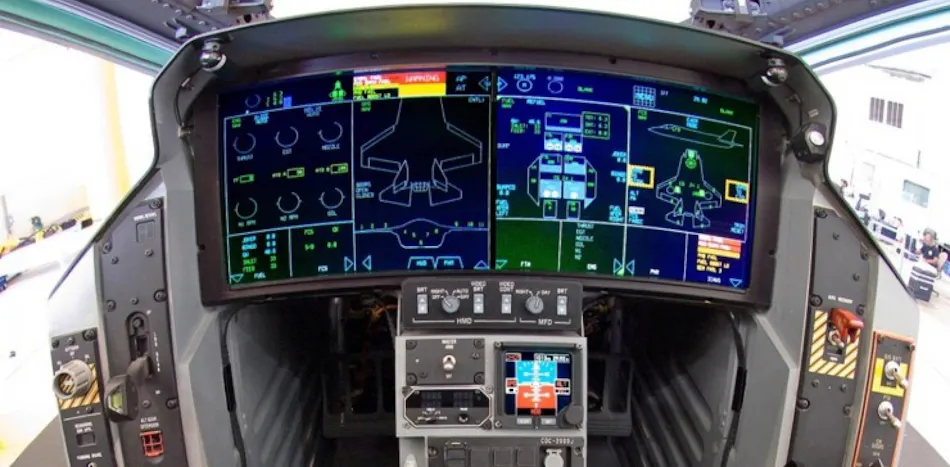

Similarly to VW, the German Air Force is striving to keep pace with competitors in terms of technology. Their solution is comparable to that of VW, as the German arms producer Rheinmetall is set to commence production of parts for the F-35 stealth aircraft in a facility located in Germany from 2025 onwards. So again, we have a joint venture deal with US-based company (Lockheed Martin) with Rheinmetall (Germany) as its partner.24
The patent connection between black and white technology research
Some of you will rightly highlight the stark contrast between developing black (military) and white (civilian) technologies. The level of secrecy is considerably higher in military projects, and this is an accurate observation. However, we are discussing software theology, which has a much broader range of applications in everyday civilian life, particularly in the development of user interfaces. Anyone with access to a computer or smart device can contribute to this field. The process of acquiring a patent is often seen only as a way for inventors to receive legal protection and compensation for their inventions in exchange for publicity. However, this view only captures half of the story.
The Slovenian Industrial Property Act (ZIL) has an article 17 called confidential inventions and it states:
»(1) An invention which is important for the defense or security of the Republic of Slovenia shall be considered confidential and shall be notified to the Ministry responsible for defense.
(2) The conditions for the exploitation of a confidential invention, in particular the payment for its exploitation, shall be agreed directly between the inventor and the Ministry responsible for defense.
(3) An application for an invention under paragraph 1 of this Article may be filed with the Office if the Ministry of Defense does not wish to use it or if it consents to the filing of a patent application. «
The German Patent Act has similar legislation in article 13 where it states:
»(1) Patents have no effect in a case where the Federal Government orders that the invention is to be used in the interest of public welfare. Further, it does not extend to a use of the invention which is ordered in the interest of the security of the Federal Republic of Germany by the competent highest federal authority or by a subordinate authority acting on its instructions.
(2) The Federal Administrative Court is competent to hear an appeal from an order made pursuant to subsection (1) if the order was made by the Federal Government or by the competent highest federal authority.
(3) In the cases referred to in subsection (1), the proprietor of the patent is entitled to equitable remuneration from the Federal Republic of Germany. In the event of dispute as to its amount, recourse may be taken to the ordinary courts. A Federal Government order as referred to in subsection (1) sentence 1 is to be communicated to the person entered in the Register as the proprietor of the patent (section 30 (1)) before the invention is used. Where the highest federal authority which issued an order or instruction in accordance with subsection (1) sentence 2 obtains knowledge of a remuneration claim pursuant to sentence 1, this authority is to communicate this to the person registered as the proprietor of the patent.«
In at least two EU member states, Slovenia and Germany, the patenting process serves a dual purpose: it is both a tool for acquiring the rights of the inventor and a search tool for usable technologies to ensure the security of a member state. It can also be seen as an established systematic approach of discovering and transferring white technology to black technology.
Conclusion
It is this author's opinion that there is a significant overlap between the challenges currently facing VW and the Bundeswehr (the German Federal Armed Forces) with regard to software development. The EU's ban on patenting software has resulted in the complete shutdown of the domestic lex specialis established systematic patenting process approach, which is used to discover and transfer white technology to black technology. VW and the Bundeswehr are implementing the same corporate logic of outsourcing software development to third parties in the US, where software can be patented, and are competing with and catching up to the same global competitors based in the USA (Tesla & Lockheed Martin) and in China (BYD & Shenyang Aircraft Corporation), where again software can be patented.
However, in contrast to VW, the Bundeswehr is in a more advantageous position, with greater resources, influence, and authority than any civilian company of equal or greater financial standing. It is therefore well-placed to provide solutions to Germany's systematic software issues. The author of this blog believes that the Bundeswehr is not concerned about Tesla's self-driving cars, but is worried of let's say always moving self-driving autonomous heavy artillery...well at least I would be.
For detailed legal advice tailored to your specific circumstances, our law firm's expertise in public procurement, construction and environmental law is at your disposal. Contact us via our website or send an enquiry to info@neffat.si.
Preprared by:
Marko Čabraja
Attorney at Law
1 https://www.euronews.com/business/2024/04/11/volkswagen-electric-car-sales-plunge-why-are-europeans-returning-to-petrol
2 https://www.theguardian.com/business/2024/oct/30/volkswagen-hit-by-fall-in-profits-sales-in-china-slump
3 https://www.reuters.com/business/autos-transportation/volkswagen-plans-major-layoffs-shut-least-three-german-plants-works-council-head-2024-10-28/
4 https://www.theguardian.com/us-news/2024/nov/27/trump-tariffs-explained
5 https://www.eea.europa.eu/en/topics/in-depth/electric-vehicles?activeTab=07e50b68-8bf2-4641-ba6b-eda1afd544be
6 https://www.dw.com/en/vw-guns-for-tesla-with-homegrown-software-developers/a-60768832
7 https://www.dw.com/en/vw-guns-for-tesla-with-homegrown-software-developers/a-60768832
8 https://www.bbc.com/news/articles/c1ddmxmz1lpo
9 https://www.maucherjenkins.com/commentary/patenting-software-in-china
10 https://www.uspto.gov/web/offices/pac/mpep/mpep-9015-appx-l.html#d0e302376
11 https://mwi.westpoint.edu/art-craft-science-think-military-leadership/
12 https://nationalinterest.org/blog/buzz/russias-mig-31-foxhound-fighter-can-hit-mach-28-210632
13 https://militarywatchmagazine.com/article/mig31-teaching-ukraine-most-dangerous
14 https://bulgarianmilitary.com/2024/11/05/close-up-look-at-j-35a-finally-lets-us-compare-it-to-the-f-35/
15 https://www.industrialcybersecuritypulse.com/networks/throwback-attack-chinese-hackers-steal-plans-for-the-f-35-fighter-in-a-supply-chain-heist/
16 https://theaviationist.com/2024/07/23/lockheed-martin-delivers-f-35-with-tr-3-software-upgrade/
17 https://militarywatchmagazine.com/article/russian-mig31bm-deliver-prized
18 https://www.bundeswehr.de/en/organization/german-air-force/eurofighter
19 https://www.dw.com/en/germanys-rheinmetall-starts-building-f-35-fuselage-plant/a-66406164
20 https://fighter-aircraft.com/eurofighter-typhoon-cockpit/
21 https://fighter-planes.com/info/su-57.htm
22 https://www.militaryaerospace.com/sensors/article/14276510/panoramic-display-f-35-cockpit-avionics
23 https://bulgarianmilitary.com/2024/11/10/exclusive-look-j-20-fighter-cockpit-photo-leaked-from-zhuhai/
24 https://www.dw.com/en/germanys-rheinmetall-starts-building-f-35-fuselage-plant/a-66406164
Odvetniška družba Neffat in partnerji o.p., d.o.o.
Miklošičeva cesta 18, 1000 Ljubljana, Slovenija
Avtorji: Spletna Postaja